Exitseries.com – A bonsai tree fertilizer provides vital nutrients that potted miniature trees cannot find naturally. Because bonsai trees live in small containers, the soil becomes nutrient-poor quickly. Without enough fertilizer, your bonsai cannot maintain its delicate balance between miniature size and vibrant health.
Fertilizing regularly ensures your bonsai tree receives the right amount of nitrogen, phosphorus, potassium, and trace elements. These nutrients support foliage, strengthen roots, and promote balanced growth. In nature, trees can extend their roots deep into the earth to find minerals, but bonsai trees depend entirely on what you give them. Therefore, using a proper fertilizer for bonsai trees is essential for long-term health and beauty.
Why Bonsai Trees Need Fertilizer
Many beginners underestimate how critical bonsai fertilizer really is. The small pot limits root space and nutrient storage. Frequent watering also washes away minerals from the soil. Over time, the bonsai will show signs of weakness — pale leaves, thin branches, and slow growth.
Fertilizing provides the nutrition your bonsai needs to recover strength, maintain its shape, and display dense foliage. Whether your bonsai is a pine, ficus, juniper, or maple, each species benefits from a consistent bonsai tree fertilizer routine. Feeding your tree regularly replicates the natural nutrient cycle of a full-sized tree in the wild.
Benefits of consistent bonsai feeding include:
- Stronger and more resilient roots.
- Healthier, greener leaves.
- Faster recovery after pruning or repotting.
- Improved resistance to pests and diseases.
A proper feeding schedule with quality bonsai plant fertilizer makes all the difference between a weak bonsai and a stunning miniature masterpiece.
Read also : House of Bonsai: Complete Care and Style Guide 2025
How to Choose the Right Bonsai Tree Fertilizer
Selecting the right bonsai tree fertilizer may seem confusing at first, but it’s easy when you understand the basics.
1. Learn the N-P-K Ratio
Each bonsai fertilizer package lists three numbers — nitrogen (N), phosphorus (P), and potassium (K). These represent the ratio of nutrients in the product.
| Nutrient | Function | Recommended Season | Example Ratio |
|---|---|---|---|
| Nitrogen (N) | Promotes leaf and shoot growth | Spring and summer | 10-6-6 |
| Phosphorus (P) | Encourages strong roots and flowers | Autumn | 3-6-6 |
| Potassium (K) | Strengthens overall tree health | All seasons | 6-6-6 |
A balanced bonsai plant fertilizer (like 6-6-6) works well for most species. Trees in early development may need higher nitrogen, while mature bonsai benefit from lower nitrogen to maintain structure and avoid excessive shoot growth.
2. Organic vs Synthetic Fertilizers
There are two main types of bonsai tree fertilizer: organic and synthetic.
- Organic bonsai fertilizer: Made from natural sources like fish meal, bone meal, or compost. It releases nutrients slowly, improves soil structure, and supports beneficial microorganisms. Ideal for beginners and long-term use.
- Synthetic bonsai fertilizer: Manufactured chemically for fast results. It’s precise and powerful but can cause salt build-up if overused. Suitable for advanced growers who monitor closely.
For best results, alternate between organic pellets and diluted liquid synthetic fertilizer. This method balances steady feeding with periodic nutrient boosts, giving your bonsai both immediate energy and long-term health.
Read also : Bonsai Peach Tree: How to Grow & Care for a Fruit Miniature
3. Seasonal Feeding Schedule
The timing and amount of bonsai tree fertilizer matter as much as the type. Different seasons demand different nutrient levels.
| Season | Ideal N-P-K Ratio | Frequency | Purpose |
|---|---|---|---|
| Spring | High nitrogen (10-6-6) | Every 2 weeks | Stimulate strong new growth |
| Summer | Balanced (6-6-6) | Every 3 weeks | Maintain health and vigor |
| Autumn | Low nitrogen (3-6-6) | Monthly | Prepare for dormancy |
| Winter | Minimal feeding | Stop for outdoor bonsai | Resting phase |
Indoor bonsai species, such as ficus or jade, can receive diluted liquid bonsai fertilizer throughout the year since they don’t go fully dormant.
4. How to Apply Bonsai Fertilizer
Correct application is key to getting the most from your fertilizer for bonsai trees.
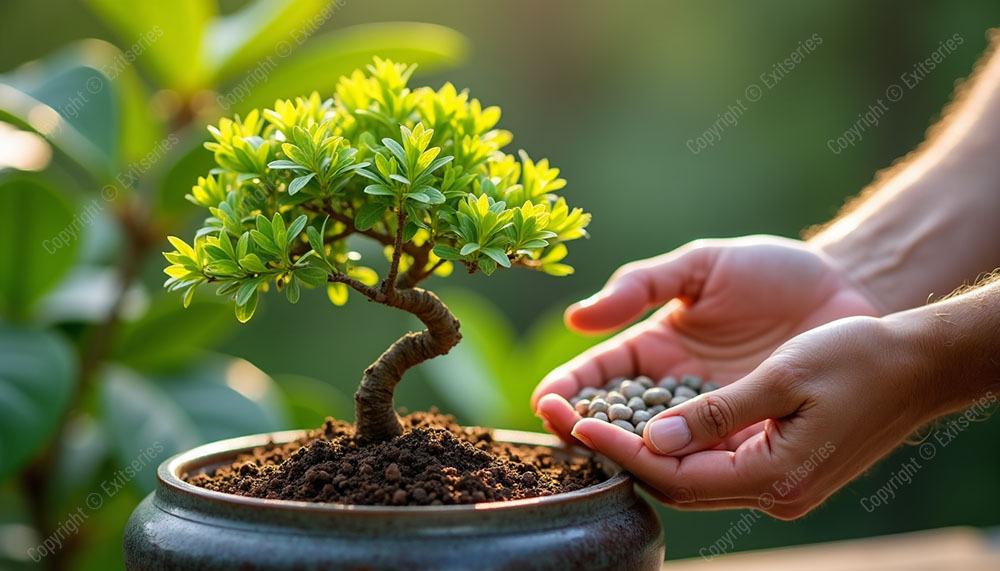
- Solid/slow-release fertilizer
Place pellets or fertilizer cakes on top of the soil. Each time you water, nutrients slowly dissolve and feed the roots. - Liquid fertilizer
Mix with water and pour onto moist soil. This provides instant feeding and works well for indoor bonsai. - Never fertilize dry soil
Always water first to prevent root burn. - After repotting, wait 4–6 weeks before applying fertilizer. Freshly pruned roots need time to recover before absorbing nutrients.
Consistency is more important than quantity. Small, frequent doses of bonsai tree fertilizer are far better than large, irregular ones.
Common Mistakes When Fertilizing Bonsai Trees
Even experienced growers sometimes make errors in feeding. Avoid these mistakes to protect your bonsai:
- Over-fertilizing: Applying too much can burn roots or cause rapid, weak growth.
- Under-fertilizing: Skipping feeding leads to poor health and weak branches.
- Using wrong ratios: High nitrogen at the wrong time may create leggy, oversized leaves.
- Fertilizing after repotting: Roots are too delicate to handle nutrients immediately.
- Ignoring species differences: Conifers, tropicals, and deciduous trees each have unique needs.
A balanced and gentle approach to using bonsai tree fertilizer will help you maintain steady, controlled growth year after year.
Read also : Find the Best Bonsai Lemon Tree for Sale Online 2025
Recommended Bonsai Tree Fertilizers
Below are some top-rated products and options suitable for different bonsai types:
| Type | Example Product | Benefits |
|---|---|---|
| Organic Pellets | BioGold Original, Tamahi | Slow release, safe, ideal for outdoor bonsai |
| Liquid Fertilizer for Bonsai Trees | Dyna-Gro, Miracle-Gro | Fast absorption, great for indoor bonsai |
| Granular Slow-Release | Osmocote | Long-lasting, easy to control |
| Homemade Organic Mix | Seaweed extract + fish emulsion | Affordable, eco-friendly option |
Each of these bonsai fertilizers provides a slightly different feeding style. Choose based on your tree species, environment, and level of experience.
Tips for Maximizing Fertilizer Efficiency
To make the most of your bonsai tree fertilizer, keep these professional tips in mind:
- Always water your bonsai thoroughly before feeding.
- Keep soil slightly moist to promote consistent nutrient uptake.
- Use high-quality soil mix with good drainage. Fertilizer is wasted if water stagnates.
- Rotate fertilizer placement (for solid types) to ensure even nutrient distribution.
- Observe your tree’s response — adjust frequency or type if leaves become pale or growth slows.
Proper fertilization, combined with pruning, wiring, and repotting, keeps your bonsai balanced and full of life.
FAQ – Bonsai Tree Fertilizer
Feed your bonsai every 2–4 weeks during the active growing season. Use a balanced bonsai tree fertilizer for most species and reduce feeding during dormancy.
Yes, but dilute it to half-strength. A dedicated bonsai fertilizer has the correct ratios for compact trees and avoids excessive shoot growth.
Too much bonsai plant fertilizer can cause salt build-up, root burn, and weak branches. Always follow dosage instructions and water well to flush excess salts.
Conclusion
Feeding your tree with the right bonsai tree fertilizer is one of the most important aspects of bonsai care. Because bonsai trees grow in confined spaces, they rely entirely on you to provide nutrition. Balanced fertilization supports healthy roots, vibrant leaves, and steady growth — the hallmarks of a beautiful bonsai.
Choose your bonsai fertilizer carefully, apply it regularly, and monitor how your tree responds. Avoid extremes — neither starving nor overfeeding. Combine smart fertilization with good watering, pruning, and sunlight exposure for best results.
With patience, attention, and a thoughtful fertilizer for bonsai trees schedule, your miniature tree will thrive, showcasing strength, balance, and timeless beauty for years to come.